Concrete Cutting Blades
We build these blades for one job — grinding through cured concrete, reinforced slabs, and everything your walk-behind or handheld cut-off saw throws at them. The segments are loaded with industrial synthetic diamonds bonded in sintered metal matrices. Hard aggregate like California river rock? You need a soft bond that sheds dull diamonds fast. Soft green concrete? Hard bond, or you'll chew through segments in an hour. That's the science behind it — matching the matrix to the material. We've been dialing in these bonds for contractors cutting freeway overlays, structural foundations, and municipal trenching jobs across SoCal for years.
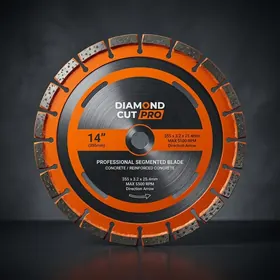
Segment Engineering & Bond Metallurgy
Mechanism of Action
Unlike standard wood-cutting blades that slice, diamond segments grind down concrete structures at a microscopic level. Synthetic diamond crystals of specific mesh size (typically 30/40 or 40/50 mesh for concrete) are suspended in a sintered metal powder bond (cobalt, bronze, iron, and nickel). As cutting progresses, the hard aggregate particles wear down the metal matrix, slowly exposing new layers of sharp diamonds. For hard California river rock aggregate, a soft cobalt-rich bond is utilized to ensure that glazed diamonds are quickly shed, preventing blade binding.
Operational Parameters
Wet cutting suppresses toxic respirable crystalline silica dust (meeting OSHA compliance) while cooling the steel core. Dry cutting segments are laser-welded to withstand extreme temperatures without segment detachment. Using a dry cutting diamond blade with water cooling significantly increases diamond life by preventing heat-induced structural fatigue on the steel core, while wet blades must never be run dry under any circumstances.
Target Material Applications
- ✓ Cured concrete and steel-reinforced concrete slabs
- ✓ Commercial foundation pours, structural columns, and load-bearing walls
- ✓ Roadway pavements, highway expansions, and airport runways
- ✓ Walkways, driveways, patios, and municipal trenching paths
- ✓ Structural demolition, seismic retrofitting, and wall cutouts
Available Sizes & Direct Pricing
| Diameter Specification | Segment & Specs | Direct Pricing | Availability & Orders |
|---|---|---|---|
| 4.5" Professional Blade | 10mm x .125" Sintered Segments | $49.99 ● In Stock | Order Direct → |
| 12" Professional Blade | 10mm / 12mm x .125" (3.2mm) Sintered Segments | $289.99 ● In Stock | Order Direct → |
| 14" Professional Blade | 12mm / 15mm x .125" (3.2mm) Sintered Segments | $299.99 ● In Stock | Order Direct → |
| 16" Professional Blade | 12mm / 15mm x .140" (3.5mm) Sintered Segments | $399.99 ● In Stock | Order Direct → |
| 18" Professional Blade | 12mm / 15mm x .140" (3.5mm) Sintered Segments | $499.99 ● In Stock | Order Direct → |
| 20" Professional Blade | 15mm x .155" (3.9mm) Sintered Segments | $599.99 ● In Stock | Order Direct → |
| 24" Professional Blade | 15mm x .165" (4.2mm) Sintered Segments | $699.99 ● In Stock | Order Direct → |
📦 Wholesale Contractor Bulk Packs
Save on high-frequency utility cutting. Get factory-direct bulk rates on 5-Packs and 10-Packs. Call us direct for contractor discounts.
Blade RPM & Depth of Cut Calculator
Calculate optimal operating parameters for your Concrete Cutting Blades.
Material Matching & Bond Selection Matrix
Pairing the correct bond hardness with your aggregate is essential for achieving optimal cutting speeds and maximizing blade lifespan.
| Job Site Material | Recommended Blade Type | Why This Spec Matters |
|---|---|---|
| Cured concrete with rebar | 14" Sintered Segmented, Soft Bond | Soft cobalt-iron bond cuts through both hard steel rebar and abrasive aggregate without glazing |
| Green concrete (< 24 hrs) | Hard-bond asphalt-type blade | Uncured concrete is abrasive like asphalt — needs hard bond + undercut protection |
| Highway / airport pavement | 20–24" Walk-behind blade | Deep cut capacity for thick roadway slabs. Wet cutting mandatory for silica compliance |
| Concrete block / CMU walls | Segmented masonry blade | Optimized segment spacing clears block debris. See masonry blades |
Verified Contractor Field Reports
Direct feedback from commercial cutting contractors across Southern California running Quality Diamond Blades on job sites.
"Ran these on a parking garage demo in Glendale. Cut through 12 inches of reinforced slab with #5 rebar and the blade still had life. Way better than what we were running before."
"Switched to QDB's 14-inch for our I-5 expansion joint work. Getting 30% more linear feet per blade and the segments aren't undercutting like our old supplier."
Frequently Asked Questions
What is the difference between wet and dry concrete blades?
Wet concrete blades require continuous water flow to cool the steel core and segments, preventing segment delamination and suppressing dangerous silica dust. Dry concrete blades feature laser-welded segments that withstand high operating temperatures, allowing them to be run without water under intermittent cutting cycles.
How do you prevent concrete blade glazing or overheating?
Glazing occurs when cutting soft aggregate concrete with a hard-bonded blade, causing the diamonds to dull without the metal matrix wearing away. To open the blade, run a few cuts through an abrasive material like asphalt or sand-block to erode the bond and expose fresh diamond crystals.
What safety standards govern concrete saw blades in CA?
Concrete saw blades used on commercial California construction sites must comply with ANSI B7.1 safety standards for abrasive wheel safety and are subject to Cal/OSHA silica dust exposure rules, mandating wet-saw attachments or integrated vacuum dust extraction.
What is the best diamond blade for cutting concrete with rebar?
For rebar-embedded concrete, use a sintered segment blade with a soft cobalt-iron bond matrix. The softer bond allows the diamonds to cut through both hard steel rebar and abrasive concrete aggregate without glazing. A 14-inch diamond concrete saw blade with 12mm or 15mm segments provides the best balance of depth and cutting speed for reinforced structural slabs.
How do you manage concrete slurry disposal on a job site?
Concrete cutting slurry contains respirable crystalline silica and must be managed per OSHA 1926.1153 and Cal/OSHA standards. Collect slurry using vacuum attachments or containment berms, allow solids to settle, then dispose of the hardened material as construction debris. Never discharge slurry into storm drains — this violates Clean Water Act and NPDES permit requirements.
Technical Guides & Engineering Field Articles
In-depth contractor guides, safety standards, and operational parameters for Concrete Cutting Blades.
General Purpose Multi-Use Diamond Blades: The Contractor's Ultimate Workhorse
Discover how multi-application general purpose diamond blades cut concrete, brick, block, roof tile, and stone on busy job sites.
Flush-Cut and Offset Diamond Blades: Cutting Tight Against Walls and Foundations
Learn how flush-cut adapter mounting plates allow diamond blades to cut flush against concrete walls, footings, and structural columns.
Segmented Rim Concrete Blades: Maximizing Depth and Speed on Walk-Behind Saws
Optimize flat sawing production with laser-welded segmented concrete blades on 13HP to 72HP walk-behind floor saws.
Equip Your Crew With Contractor-Grade Blades
Contact our Santa Clarita technical specialists to discuss bulk contractor discounts, custom arbor sizes, and emergency job site delivery.
Call (661) 592-1022